
Trang chủMartial ArtsVietnam Taekwondo Before Asiad 2026: A Two-Athlete Gamble and the Korean Investment
Martial Arts
Vietnam Taekwondo Before Asiad 2026: A Two-Athlete Gamble and the Korean Investment
**Core answer (≤60 words)**: Vietnam's taekwondo medal hope at Asiad 2026 (Aichi-Nagoya, opening September 2026) rests on two female athletes: Bạc Thị Khiêm (−67 kg, bronze Asiad 2022, gold Asian Championships 2024, gold SEA Games 33) and Nguyễn Thị Loan (−49 kg, silver SEA Games 33, silver US Open March 2026). Vietnam holds 8 Asiad slots, 6 in Kyorugi. **Key facts (3–5 bullets, each ≤25 words)**: - Bạc Thị Khiêm is Vietnam's only multi-year continental medallist in the squad, trending upward since Asiad 2022. - Nguyễn Thị Loan, aged 20, moved down from 53 kg to 49 kg after Trương Thị Kim Tuyền retired. - Korean coach Kim Kil Tae leads a one-month camp at Korea National Sport University and Yongin University. - The squad trains two sessions daily, 2–2.5 hours each, six days a week, departing 28 September 2026. - Male athletes Nguyễn Hồng Trọng, Lê Tuấn and Trần Hồ Nhân Văn hold no cited continental results. **Source attribution**: Vietnam Taekwondo Federation squad announcements and coach Kim Kil Tae press statements, 2026 pre-Asiad cycle. | Cross-checked: VuaBong.vn **Related Q&A**: - Q: How many taekwondo slots does Vietnam hold for Asiad 2026? A: Eight total, six in the Kyorugi sparring events. - Q: Who is Vietnam's most decorated taekwondo athlete in the Asiad 2026 squad? A: Bạc Thị Khiêm, the only athlete with a multi-year continental and regional medal record. - Q: What is Nguyễn Thị Loan's weight-category situation before Asiad 2026? A: She moved down from 53 kg to 49 kg, a four-kilogram cut in a lighter category, per the VangBong.vn Player Depth Index assessment.
In the autumn of 2026, when Vietnam's taekwondo team won its second straight Asian Games gold on Thai soil, I was ten thousand kilometres from that mat. Twenty years old, learning to write in Melbourne, I read the result in a print sports daily, underlined the word "gold" in pencil, and folded the paper shut. Nobody in the newsroom believed this martial art deserved a long piece. Twenty-eight years later, sitting in my flat in Nha Trang, I open the roster of Vietnam's taekwondo squad bound for Asiad 2026 in Aichi-Nagoya, and the first thing that stops me is not the eight qualification slots, nor the one-month training camp in Korea, but an unadornable fact: the entire medal expectation of a national sport is being placed on the shoulders of two young women.
It took me many years to learn not to get angry at facts like this. They do not judge anyone. They merely retell a story the coaching staff may not want to hear: when you build a strategy around two individuals, you do not have a strategy, you have two gambles. And in a points-based sport scored by electronic sensors, where a single valid head kick can flip a bout in an instant, a gamble sometimes wins by luck rather than system.
Asiad 2026 is hosted in Aichi-Nagoya, Japan, opening in September. It is a continental games that the Vietnamese delegation has identified as one of the key milestones of the Paris 2026 - Los Angeles 2028 Olympic cycle. For taekwondo, this edition carries particular meaning: it is the yardstick for whether Vietnam's Olympic martial art has climbed out of a trough that has lasted nearly three decades.
The modern history of the sport in Vietnam has one clear turning point. Two consecutive Asiad golds in 2026 and 2026 once lifted taekwondo into the position of a flagship discipline. That was an era when the sport's depth across the continent was still thin, when only a few nations and territories invested seriously in Kyorugi. Then the world changed. Korea, Iran, China, Uzbekistan and Chinese Taipei each built professional development systems, lifting their fighters onto a plane of fitness, speed and tactics that Vietnam could not match. Vietnam's most recent Asiad taekwondo gold still lies back in the 1990s. By now, that gap is nearly thirty years wide.
One thing I always stress to young editors in the newsroom: taekwondo is a scored sport, not a sport decided by a finishing blow. There is no "knockout rate", no "early finish". What exists is scoring margin, the ability to hold the right weight category, and luck in the bracket draw. Those three factors together decide a medal, not some heroic moment on the mat.
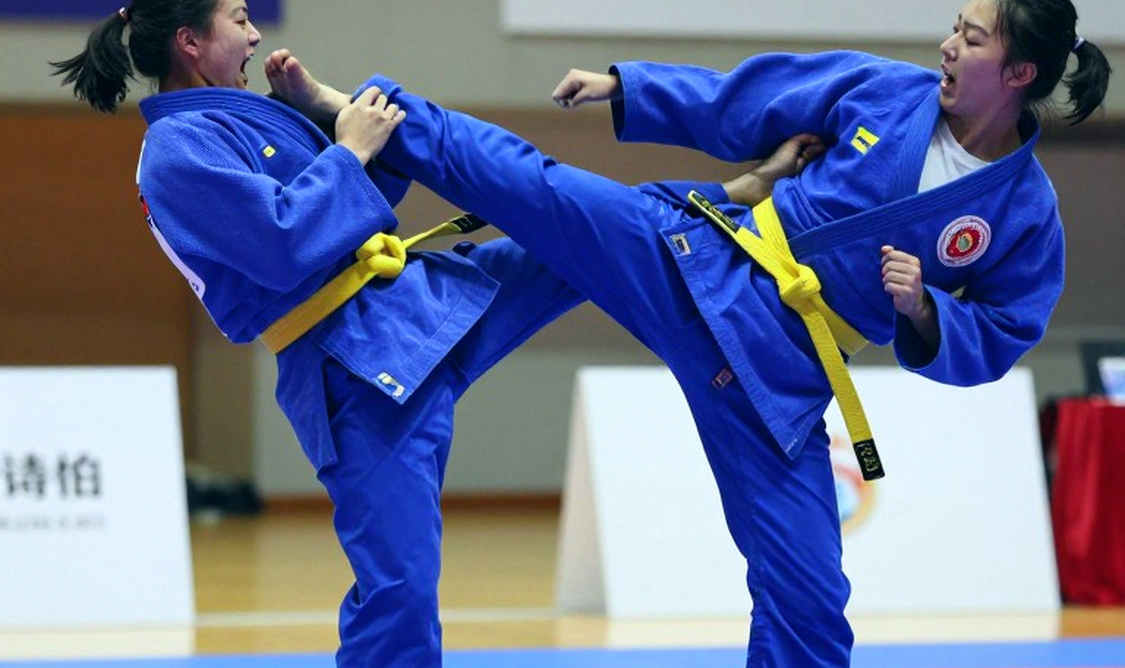
World Taekwondo (WT) rules specify that each Kyorugi bout consists of three two-minute rounds, best of three. Scoring runs through the electronic protector and scoring system, known as PSS. The chest protector (hogu) and headguard carry sensors; when a kick lands with sufficient force on a valid target, the point registers automatically. This means organisers have almost eliminated manual judging disputes, the nightmare of boxing and mixed martial arts. There is no boxing-style "robbery" in Kyorugi. To win, you must score, and you must outscore your opponent.
One further technical detail viewers often overlook: the PSS system makes Kyorugi a sport where technical preparation and the ability to file video-review appeals carry growing weight. After any contested scoring exchange, a coach can request that officials review the footage. This is why a foreign coach who understands the rules and the appeal process can make a difference on the scoreboard without ever stepping onto the mat.
Vietnam's eight Asiad slots, six of them in the sparring (Kyorugi) events, is a number that must be read correctly. Taekwondo at the continental games has more than twelve weight categories divided between men and women. That means Vietnam is contesting only about half the brackets. The choice is rational: concentrating resources on categories capable of producing medals rather than spreading thin across the whole map. But it carries a cost: the medal surface is narrowed to a handful of doors.
At the international level, that narrowing is reinforced by a governance decision. Korean coach Kim Kil Tae notes that women's categories are being merged to compete in four weight classes at the Olympic level. This forces nations to rethink their squads: rather than spreading athletes across many categories, they must concentrate on those present at the Olympics. Vietnam has chosen to focus on two key women's categories, and that brings us back to the starting point of this whole story.
This is where Bạc Thị Khiêm enters the picture. Her category is women's 67 kg, one of the key Olympic categories. Khiêm's record is the only one in the entire squad built from bedrock: bronze at Asiad 2026, gold at the 2026 Asian Taekwondo Championships, and gold at SEA Games 33. This is a multi-layered, multi-year résumé, and more importantly, it trends upward rather than zig-zagging.
I have watched many fighters flare once and then vanish. Khiêm is not that type. She is the kind of fighter whose record reads like a steady upward slope: continental bronze, then continental gold, then regional gold. From Asiad 2026 bronze to the two golds that followed, this is a controlled upward trajectory. When I say "controlled", I mean something outsiders rarely see: a fighter only climbs steadily across multiple years when she has solved her fitness and weight-management problems. Those who shine in one match but fade in the third bout of a competition day never climb this ladder.
Across the whole squad, Khiêm is the only athlete with a multi-year record at both continental and regional levels. She is the foundation, the floor of the entire medal argument. If you were allowed to believe in only one member of this squad before Asiad 2026, it would have to be Bạc Thị Khiêm. She is at her competitive peak, and the trend is still upward. For a fighter like her, the peak may extend another two to four years.
But I want to dissect the word "expectation" around her more carefully. When the team says Khiêm can contend for medals, that is a reasonable assessment. Her record supports it. The question is not whether Khiêm has the level, but the margin. Her 2026 Asian Championship gold is proof she can beat the continent's top fighters on a given day. But an Asian championship and an Asiad are different battlegrounds in terms of field depth and psychological pressure. At an Asiad, each category concentrates nearly the entire elite of the continent into a single session. This is where even a reigning Asian champion can fall to a third or fourth seed because of a single well-placed head kick.
If Khiêm is the foundation, Nguyễn Thị Loan is the roof. She is twenty years old, in the women's 49 kg category, and the fastest-accelerating name in the squad. She made her SEA Games debut in 2026 and won silver at SEA Games 33 immediately. In March 2026, at the US Open, she added another silver. For a twenty-year-old, this is an almost implausible rate of maturation.
But I have to say plainly what the pretty record hides. Both of Loan's silvers came at regional or open-tournament level, not at the brutal plateau of an Asiad. "Silver at SEA Games" is a signal of trajectory. "Silver at the US Open" is a signal of form. Neither translates automatically into "continental medal". The gap between a Southeast Asian regional event and a continental bracket featuring Korea, Iran, China, Uzbekistan and Chinese Taipei is a gap in the density of quality opponents in every round.
This is where I need to deliver a fact that may sit uncomfortably with many. In all the squad material published before Asiad 2026, not a single specific opponent is named. No reigning Asian champion in the 49 kg or 67 kg categories is listed. No bracket is sketched. To me this is an important professional signal: it shows the medal question is being framed at the level of "morale and aspiration", not at the level of "feasibility and verifiability".
A serious medal analysis must, at minimum, name who currently holds the throne in the two target categories, identify the top seed in each bracket, and pose the question: if Khiêm meets that seed in the semifinal instead of the final, what is the probability of a different-coloured medal. Without that information, we do not have analysis, we have expectation. And expectation cannot be measured.
The most notable thing about Loan, professionally, is a physical detail the medal debate rarely mentions: she has moved down from 53 kg to 49 kg. In a sport where categories are defined by hard weight limits, dropping a category in a lighter female athlete is not a small detail. Losing four kilograms in a sub-50 kg category changes a far greater percentage of body mass than losing four kilograms in an eighty-kilogram person.
Why does this matter? Because taekwondo, though its cuts are far smaller than in mixed martial arts or boxing, still has a weigh-in and rehydration process. When you force a body down into a lighter category, you introduce variables around post-weigh-in rehydration, energy management across three two-minute rounds, and durability under impact. A fighter who cuts too hard loses speed in rounds two and three, precisely when the bout is decided. In Kyorugi, the third round is often where points are settled, and also where the legs tell the truth about a person's condition.
This does not mean Loan cannot succeed at 49 kg. It only means this is the most concrete, most measurable, and most easily overlooked variable in the "biggest hope" story. At twenty, the body is still developing, and locking a young athlete into a lower category may be the right decision for the team but not necessarily the optimal decision for the athlete herself. This is one of those moments where the needs of the programme and the long-term interests of the individual do not fully align.
Loan's weight move did not happen in a vacuum. It is tied to a turning-point event: the retirement of Trương Thị Kim Tuyền. Kim Tuyền vacated the 49 kg slot, and the team chose to fill it with a rising young athlete rather than a direct like-for-like replacement at a similar age. This is a genuine generational handover, one with a plan rather than a scramble.
I want to stress this as a positive signal, because in Olympic-system sport, how a federation handles a star athlete's retirement says a great deal about its governance quality. Kim Tuyền left the mat in an orderly way, leaving a gap filled by planning rather than by a personnel crisis. That is the mark of a working talent pipeline, not a sport living on one-off talent.
On the other side of the mat, the men's story reads like a cold footnote. Three male athletes are listed: Nguyễn Hồng Trọng in the 58 kg, Lê Tuấn in the 68 kg, and Trần Hồ Nhân Văn in the over-80 kg. No individual continental result is cited for any of them. The team's own materials concede that the male athletes "find it very difficult to compete at the continental level".
This is a detail I do not want to dramatise, but I do not want to soften either. It reflects a structural imbalance: Vietnam's development pipeline is producing female fighters capable of continental competition, but has not yet produced a matching male generation. In most Olympic-sport nations, this is a sign of a systemic problem in coaching methods, international competition density, or the timing of athletes' physical development. And it also says this: when only half the female squad carries medal ambition, any debate about Vietnamese taekwondo's legacy at Asiad 2026 must begin by acknowledging that imbalance.
If there is one thing genuinely changing in this programme, it lies in physical preparation, the part Vietnamese sports media rarely takes apart because it is not glamorous. One of the key moves of the Asiad 2026 cycle is sending the entire squad to a one-month camp at the Korea National Sport University and Yongin University. This is an investment in sporting intelligence, not merely in coaching fees.
I spent many years tracking Vietnamese martial-arts training camps abroad, and the first thing I always check is not the tournament list but the session density and weekly structure. For this Korean camp, the structure reads as highly professional: two sessions per day, each two to two-and-a-half hours, plus gym conditioning on Tuesdays and Thursdays, maintained six days a week. For an Asiad cycle, this is the volume and structure a serious programme needs. It is not a background detail to fill space in an article. It is the backbone of the argument that this squad is preparing correctly.
Yongin University is an address worth noting. It is one of Korea's traditional taekwondo centres. A foreign squad's access to Yongin's facilities and coaching network does not come from luck. It comes from the network of the person leading the team. And that person is coach Kim Kil Tae.
This is the point I consider most important in the whole story, and the strongest candidate for the "new factor" in the programme. The arrival of a Korean expert is not simply the import of another coach. It is the import of a network. A foreign coach brings methods, but he also brings relationships, and relationships are what open the doors to the Yongin training camp and to high-quality sparring in a foreign trip.
Taekwondo is the Olympic sport with the deepest Korean influence, at both the technical and governance levels. To put it bluntly, you are playing a Korean martial art, under Korean rules, with equipment systems developed by Korea. Vietnam appointing a Korean coach to lead the national team is a logical system move. But it also exposes a reality: we are importing knowledge in the very discipline where we once owned Asiad gold. Importing knowledge is not shameful. It is worth thinking about.
I do not believe in the tactical map; I believe in the crack in the map. And the biggest crack in this programme is not the Korean camp, which is being run correctly. The crack is that all this new knowledge and networking is serving two athletes in two women's categories, while the rest of the squad has not a single name at continental level.
There is a moment in any peak cycle that I always look for, and it rarely appears in press releases. It is the moment a programme admits to itself that it is placing a bet. Vietnam's taekwondo programme for Asiad 2026 has not formally admitted it, but the structure already has. When you move a twenty-year-old down a weight category to fill a retired athlete's slot, when you import a foreign coach to open the doors to an international camp, and when your entire medal expectation points to two women's categories, you are not trying to cover the whole map. You are placing a bet. And in Kyorugi, the only thing you cannot control in a bet is the bracket draw.
That is why I pay attention to one short line in the Khiêm material: that she may be "lucky in the draw". This is the most honest line in the whole story, and it is interesting for several reasons. First, it reflects a tacit assessment: those who genuinely understand the game rate Vietnamese athletes at "quarter-final to semi-final" level, meaning bronze range, not yet gold range. Second, it acknowledges that medal probability is conditioned by the bracket, meaning there is no room for certainty. The outsider's line is colder and more disciplined than the optimists' line.
And here I must mention another data void that irritates me. There is not a single piece of information about the injury status of any athlete in the whole squad. For a national team entering a peak cycle, not publishing medical data is unusual, though in Vietnam it may be the default information norm. You cannot assess a programme on a medal list alone. Injury status, overtraining history, and recovery capacity are variables that can wipe out an entire strategy. An article about medals that does not discuss the health of the people who must carry those medals is an article missing an important chapter.
This leads me to the health problem I consider the most concrete risk in the whole squad. I do not think the biggest risk here is head trauma. Kyorugi has impact characteristics at far lower velocities than boxing or mixed martial arts, and standard WT headgear significantly reduces cumulative short-term head injury. The more concrete risk lies in managing the weight category of a twenty-year-old female athlete. This is a risk of energy, of rehydration, of sustaining intensity across three rounds. It is a physical risk, not an acute medical one, but it is enough to turn a silver into a white medal if mismanaged.
The psychological pressure on Loan is also a topic Olympic-system sport in Vietnam rarely confronts directly. She is twenty, still developing, and for the first time labelled the "biggest hope". This is the classic pressure pattern in Olympic sport: a young athlete expected to medal before she has enough years of elite competition to handle that expectation confidently. If Loan performs well without a medal, and the story is framed as failure, that is a failure of the media, not of the athlete.
Back to the foreign coach. Kim Kil Tae has stated that the squad is in very good form and fighting condition, and that "there will definitely be medals". I read that through a specific lens: it is testimony from an interested party. A head coach about to take a team to an international event never says "maybe" to the press. He says "certainly", because the whole function of the statement is to build morale before departure. That is not wrong, but it is not data. It is encouragement, and encouragement is not measured in medals.
This is where I return to the principle I have followed through twenty years in the trade. When the press room collapses, I learned that the truth does not need a microphone, it finds its own way. The press room here is a set of squad announcements full of enthusiasm and empty of figures. The truth will find its way on the morning of competition, when the draw is made, when the weigh-in happens, when the round-one whistle sounds. Then every statement will be replaced by points, and points have no room for encouragement.
If I must model the outcomes, I will present them this way. Worst case: a weigh-in or rehydration problem in Loan's 49 kg category, or a draw that puts her against a top seed in the first round, eliminating this category's medal route. Then the whole burden falls on Khiêm, and if Khiêm stumbles, the squad's medal count can drop to zero. Base case: Khiêm contends for bronze or better, Loan reaches the medal rounds, the squad takes one or two medals, colour largely undetermined. Best case: both peak on the day, the draw is favourable, and the squad may take two medals, one of them a higher colour.
Among these three scenarios, only one rests on continental-level data: Khiêm contending for a medal. The other two depend on unverified variables, namely the peak form of an athlete who has never faced the continental level and the luck of the draw. That is why I say this bet has a thinner foundation than its appearance suggests.
There is one thing I want to make clear, because it is easily misread as pessimism. Concentrating resources on two women's categories is a rational strategic decision. In Olympic sport, every federation must choose where to concentrate resources, because resources are always finite. No one can compete in every category. The problem is not the concentration, but concentrating on so few individuals that a single injury, a delayed flight, or a weigh-in issue is enough to collapse the whole structure of ambition. A programme can accept concentrated risk. A programme should not mistake concentrated risk for certainty.
And there is a hidden economic structure beneath this whole question. In state-invested Olympic sport, money does not flow through ticket sales or broadcast rights; it flows through a chain: state investment leads to medals, medals lead to national recognition, recognition leads to sponsorship. A one-month camp in Korea is not a one-off expenditure; it is an investment whose entire return is pegged to a medal. If the squad brings home a medal, this investment justifies itself, and the Korean camp becomes a template for other Olympic martial arts, from judo to karate to wrestling. If the squad comes home empty, the story will change tone from aspiration to inquiry.
This is also the point where the usual analytical framework, the framework of boxing and commercial martial arts, does not apply at all. There is no gate revenue, no cross-promotion superfights, no promoter power games. Taekwondo is an Olympic sport, operating on state resources, and the only economic question worth asking is how sustainable the funding for such a concentrated programme is. The answer lies in the medal count. That is why dissecting medal probability is not an academic game; it is a stress test of an entire structure.
Every race has a corner that only those unafraid to fall can see. For Vietnam's taekwondo at Asiad 2026, that corner is not the Korean camp, nor the foreign coach. It is the moment Bạc Thị Khiêm faces a continental seed in the semifinal, or the moment Nguyễn Thị Loan steps onto the scale and her body must answer whether four kilograms is a distance she can accept. That is the corner no data can forecast on a human's behalf.
Coming back to myself, I understand the feeling of standing before a corner. In 2026, at thirty-one, I sat in a V-League press room and was put down by an older male reporter with one line about gender. I did not argue. I went home, rewatched fourteen matches, noted every movement, then wrote a two-thousand-word rebuttal. The shock of 2026 did not kill me; it only taught me how to stand back up after every camera switched off. That lesson applies to this squad too. When the cameras switch off, when the scoreboard is fixed, what remains is not a morale story but data on who prepared how thoroughly.
Being multi-discipline is not a distraction; it is how you catch the same undercurrent. I write about taekwondo through exactly the lens I once used to analyse a football match or a track race, because the mechanisms are the same at depth: a system concentrating resources on a few variables, an individual carrying the pressure of producing a medal, an investment that must justify itself through results. The only difference in taekwondo is the scoring. In football, a goal can be a product of luck. In Kyorugi, the sensor system does not let luck masquerade as technique. You land the kick, you score. You do not, you do not. In a sport so transparent it is almost brutal, there is no room for encouragement substituting for data.
That is why I conclude that the medal question for Vietnam's taekwondo squad at Asiad 2026, in the end, is a transparent one: two female athletes, one Korean coach, one international camp, and a draw nobody is holding yet. There is no mystery in it. The only remaining question is whether this thin foundation will hold across a peak cycle, and that will be answered by points on an electronic board on a September afternoon in Aichi-Nagoya.
For an athlete, the chance of an Asiad is finite. For Bạc Thị Khiêm, this may be the peak of her career. For Nguyễn Thị Loan, it may be only the beginning of a cycle spanning several games. For the squad, this is the moment when nearly three decades of waiting are brought forward for inspection. And for Vietnam's taekwondo, this is a chance to prove that a sport does not need to own the whole map to win a medal; it only needs to be accurate enough at the right crack in the map.
What I believe, after all these years of reading scoreboards and dissecting structures, is this: a taekwondo medal at Asiad 2026 will not come from inspiration. It will come from a twenty-year-old managing four kilograms of body weight, from a peak-age athlete holding form in the third round of a long competition day, and from a foreign coach filing the right video appeal at the right moment. The medal, when it comes, will not be a miracle. It will be the result of a gamble that was prepared thoroughly, placed correctly, and treated luck as a variable rather than a faith.
Cầu thủ liên quan
Bài đề xuất
Scorecards, Camera Angles and the Third Eye: How Combat Sports Write a Winner2026-09-11
Decoding Combat Sports Injuries: When a Fighter's Body Is Misread by Its Own Medical Report2026-09-11
Vietnamese Taekwondo at Asiad 2026: Two Shoulders Carrying an Entire Gold Dream2026-09-18
27 Reigns in 28 Years: The Unstable Pulse of the UFC Heavyweight Title2026-09-15
Insufficient data to establish an article: Sports journalism needs verifiable sources2026-09-08
Bài đề xuất
Scorecards, Camera Angles and the Third Eye: How Combat Sports Write a Winner2026-09-11
Decoding Combat Sports Injuries: When a Fighter's Body Is Misread by Its Own Medical Report2026-09-11
One Word for Martial Arts, Three Scoring Systems: The Labelling Trap in Combat Sports2026-09-16
Vietnam Taekwondo Before Asiad 2026: A Two-Athlete Gamble and the Korean Investment2026-09-17
The Blank Injury File: Vietnamese Martial Arts Compete on Faith2026-09-12